January, 1928. Cambridge, England. Paul Dirac, a fellow of St John's College, publishes an equation describing the behavior of electrons at relativistic speeds.
The equation has two solutions. One describes an electron with positive energy. The other describes an electron with negative energy, which should be impossible. Dirac spends three years trying to explain the second solution away. In 1931, he concedes. The second solution must describe a new particle, an antielectron, identical to the electron but with opposite charge.
Four years later, at the California Institute of Technology, Carl Anderson photographs a strange track in a cloud chamber. A mark curved by electric fields following the same route as an electron, but in the opposite direction. He names it the “positron”: the elusive positive electron. The impossible particle from Paul Dirac’s equations had been found.
Collecting his Nobel Prize in 1933, Dirac proposes something larger still: every particle in nature has an antiparticle. This universe is made up of both matter and antimatter.
Antimatter soon barrelled into the collective imagination of scientists and sci-fi writers. Jack Williamson's 1942 'Seetee' stories imagined an interplanetary civilisation powered by antimatter asteroids. By 1947, Fermi and Teller were publishing the theoretical groundwork for antimatter weapons (tldr, not a good idea). By the time Star Trek aired in the 1960s, antimatter was the assumed fuel for the Enterprise's interstellar voyages.
But almost a century after Anderson’s discovery, we’re still not producing enough antimatter for its most ambitious potential applications. The gap is so wide that most physicists are skeptical of any near-term change.
This is a brief introduction to the applications of antimatter: why antimatter is useful; what we’ve achieved so far; what we could achieve; and whether the skepticism holds up.
I: Antimatter 101
Antimatter is, to a very good approximation, matter's mirror image. For every particle there is an antiparticle, all have the same mass as their mirror, many have the opposite charge. Some particles are even their own antiparticle!

Now, why is antimatter interesting beyond scientific curiosity? E = mc² says mass and energy are equivalent. If we could convert mass to energy efficiently, almost everything we use energy for would get cheaper.
The problem is that converting mass to energy is extremely hard. Nuclear Fission gets you about 0.1% of your mass into energy. Nuclear fusion? A bit better, 0.3% to 0.7%.
When matter meets antimatter, the two annihilate. So if there was more antimatter in the universe it would be bad news for us citizens of the matter universe (and for those of the antimatter). But curiously, there is not. It’s one of the great questions of physics. Where hath all the antimatter gone?
And what do I mean by annihilate? I mean exactly that, total destruction. In an anti-matter/matter interaction the particles that go in have effectively all of their mass converted to energy in the form of high energy particles like photons, leptons, antineutrinos, pions and other things you didn’t know existed until now.
Proton-antiproton annihilation converts essentially all of the combined mass to energy. You lose about 40-50% to neutrinos that you can’t harness but that remaining 50% packs a punch. 500x fission, 75x fusion, or ten billion times more than oxygen-hydrogen combustion on a pound for pound basis.
This efficiency means that antimatter is, or could be, especially valuable in applications that need to extract a lot of energy from a little mass. Medical imaging. Cancer treatments. Spacecraft propulsion.

II: Medical imaging
In the early 1950s, William Sweet and Gordon Brownell built a brain scanner at Massachusetts General Hospital that detected positron-emitting isotopes in tumours. Their scanner evolved into positron emission tomography (PET).
PET is used in hospitals worldwide to stage cancers, assess heart muscle after a heart attack, diagnose Alzheimer's, and do a dozen other things. Roughly two million scans are performed in the US each year. PET is feasible because positrons are cheap. They fall out of certain radioactive isotopes as they decay: fluorine-18, carbon-11, oxygen-15, and a handful of others used routinely in nuclear medicine.
In PET, these radioactive isotopes are used as “tracers”. A tracer does two jobs. It gathers in the tissue the doctor wants to image. And once it's there, it decays and emits positrons. Each positron annihilates with a nearby electron almost immediately, within a millimetre or two of where it was emitted. The annihilation releases a pair of gamma rays travelling in opposite directions. A ring of detectors around the patient catches the gamma rays, traces them back to their origin, and assembles a three-dimensional map of wherever the tracer went.
Positrons are also used in materials science to detect defects in metals and semiconductors, by a related technique called positron annihilation spectroscopy.
But positrons can't deposit energy inside the nucleus: they annihilate with electrons in the surrounding cloud, and the resulting gamma rays escape the tissue rather than depositing their energy locally. Antiprotons annihilate with the nucleons themselves.

III: Cancer treatments
In 1984, Lewis Gray and Theodore Kalogeropoulos, two physicists at Syracuse University, proposed that antiprotons could be used to treat cancer. They called the technique focused radiation transfer. The paper sat untested for two decades. CERN's Antiproton Decelerator came online in 2000.
Proton therapy already exploits a useful property of charged particles: as they slow down in tissue, the rate at which they deposit energy rises sharply, spiking just before they stop. The location of this spike is called the Bragg peak. A proton beam can be tuned so the peak sits inside the tumour. As each proton comes to rest there, it ionises atoms along its final millimetres, breaking the chemical bonds that hold tumour-cell DNA together. The cells die. Healthy tissue along the path gets a fraction of the dose. The tumour gets the vast majority.
Antiprotons behave like protons on the way in and stop at the same depth. The difference is at the stop. A proton runs out of energy. An antiproton annihilates with a nucleon and releases nearly 2 GeV of extra energy. The biological damage at the tumour is around four times that of a proton beam delivering the same dose to surrounding tissue.
In 2006, CERN's ACE collaboration measured this 4x damage factor using hamster cells. But no treatment course has yet been carried out. A single human treatment course needs around 10¹⁰ antiprotons. That's roughly equivalent to our current annual production of antiprotons.

A visualisation of the Bragg peak
IV: Spacecraft propulsion
In popular culture, antimatter’s canonical application is rocket propulsion that enables radically accelerated spaceflight. Antimatter comes into contact with matter. The two annihilate. The energy is channeled out the back of the spacecraft as thrust. The dream is interstellar travel within human lifetimes.
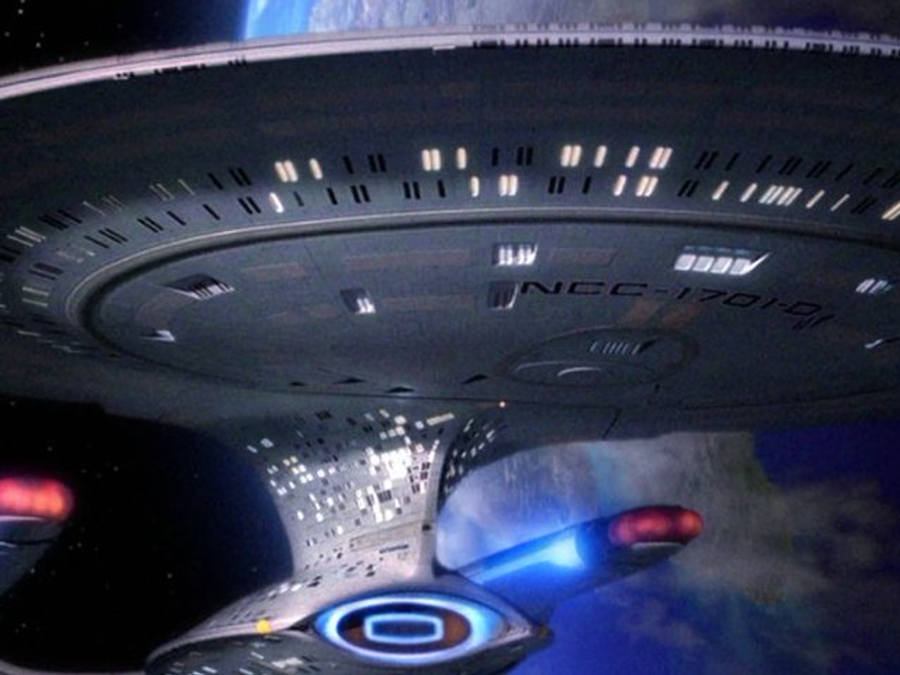
In Star Trek, the Enterprise runs on matter-antimatter annihilation. This pure version of the dream needs kilograms of antimatter. A robotic probe to Alpha Centauri would need around 100 kilograms of antiprotons, 10²⁸ particles to get there in a hurry. Humans have produced 10¹⁶ in total. That gap is not closing soon.
But there are feasible near-term alternatives. ICAN-II, developed at Penn State in the 1990s, uses antiprotons as a trigger for a fission-fusion process. A pellet of deuterium-tritium and uranium-238 is compressed by external beams. At peak compression, a few nanograms of antiprotons are injected. The antiprotons are absorbed by the U-238 nuclei and trigger a hyper-neutronic fission reaction. The fission heat ignites the D-T core. The expanding plasma is channeled out the back to produce thrust.
ICAN-II would take thirty days to get to Mars, versus the six months required on a chemical rocket. You would still need quite a bit of shielding for the crew but the first missions to use this kind of propulsion would almost certainly be uncrewed. To give a sense of the performance shift, NASA's Juno spacecraft took five years to reach Jupiter on chemical propulsion and gravity assists. The same trip on ICAN-II would take around six months.
In all human history we have produced 10¹⁶ antiprotons. Each Mars mission would theoretically require an order of magnitude more. A big step up? Yes. Impossible? No.
But it’s not just production we need to figure out. It’s separation, storage and eventual manipulation to our applications. Remember, if this stuff interacts with pretty much anything in our world it goes out with a very tiny boom (growing in size as you accumulate more of it of course).

IV: What would it take?
With cumulative human production of antiprotons sits at 10¹⁶, and annual production around 10¹⁰. A cancer therapy course needs 10¹⁰. A Mars mission needs 10¹⁷. An interstellar probe burning straight antimatter, 10²⁸. One year of global supply treats one patient. The Mars mission alone needs more antimatter than humans have ever made.
These gaps are widely read as evidence the applications are out of reach. But the size of a production gap is a poor guide to whether it can be closed. In 1940, total world production of isotopically separated uranium-235 was on the order of micrograms. By 1945, the Manhattan Project was producing kilograms. By the 1960s, stockpiles ran to hundreds of tonnes. Twelve orders of magnitude in two decades. More recently, Lutetium-177, the workhorse beta-emitter for targeted radionuclide cancer therapy, scaled from research-scale quantities around 2000 to on the order of 100,000 patient doses a year today, delivered through a global network of reactors and processing facilities. Four orders of magnitude. No wartime mobilisation. Just clinical demand and the infrastructure built to meet it.
Antimatter has never had that infrastructure. Every antiproton in human history has been a by-product of machines built for fundamental physics. CERN's Antimatter Factory is the right facility for the questions CERN asks and takes us closer to the answers around production, capture and storage. It is not, and was never meant to be, a production line.