"Why don't you fix your little problem and light this candle?"
— Alan Shepard, May 5, 1961, strapped to a Redstone rocket, after four hours of launch delays. Fifteen minutes later he was the first American in space.
On March 16, 1926, on a farm in Auburn, Massachusetts, Robert Goddard lit the first liquid-fuelled rocket. It rose 41 feet, flew for two and a half seconds, and came down in a cabbage field.
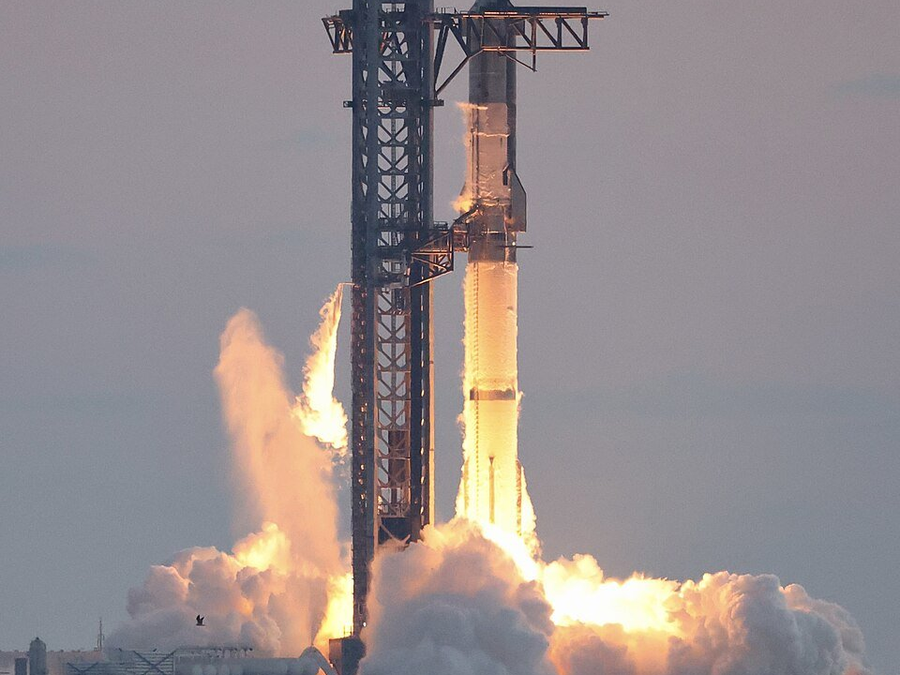
A century later, Starship stands 120 metres tall on a pad in South Texas. It weighs five thousand tonnes and produces roughly twice the thrust of the Saturn V, the rocket that sent Apollo to the Moon. Underneath, it is Goddard's machine: mix fuel with oxidiser, ignite, throw the exhaust out the back.
Every rocket that has ever reached orbit has worked this way. Every satellite, every probe, every astronaut left Earth riding a chemical burn. A hundred years of rocketry, and we have never launched with anything else.
That is not for lack of better ideas. Getting off Earth means producing more thrust than the rocket weighs. Only chemical rockets have cleared the bar, and clearing it comes at a price: nearly everything the rocket lifts is its own fuel. Of Starship's five thousand tonnes, more than nine in every ten are propellant. That ratio falls out of a single equation, published in 1903, twenty-three years before Goddard's rocket left the ground.
This is a brief introduction to how rockets leave Earth: why launch demands what it demands, how chemical rockets answer it, and why the same chemistry that gets us to orbit struggles to take us further.

The need for thrust
Spacecraft need to generate thrust
Let’s start with the obvious. If a rocket is going to reach orbit, its velocity needs to change: it starts from zero on the launchpad.
If you want to change velocity, you need to push in the opposite direction from the one you want to move in. When LeBron jumps to the rim, he pushes off the floor. When a plane flies forwards, it pushes air backwards.
But a rocket has nothing external it can feasibly push against. There's air near the ground, and plane propellers and jets can push against it. But air is thin: it can’t push back with a force anywhere near strong enough to lift the rocket. And there's less air the higher you climb. By the time you reach Low Earth Orbit (LEO), you’re practically in a vacuum.
What do you do if your environment doesn't give you anything to push off? You sacrifice something you have with you and push off that instead. If a rocket needs to climb upwards, it needs to push downwards on something it already has onboard. In practice, it looks like the rocket is throwing that thing out of the bottom. A rocket climbs for the same reason a gun kicks: if you throw mass forwards, you get shoved backwards. This push is thrust.
Launch demands enormous thrust
Thrust comes from two things: how much mass you throw out the back each second, and how fast you throw it. Mass-per-second times exhaust speed. The mass you throw to create it is the propellant.
Picture a rocket launching from the pad. Weight pulls it down. Thrust is trying to push it up. The ratio between them is the thrust-to-weight ratio (TWR).
If TWR is <1, the rocket stays on the pad. But if it's >1, it starts moving up. The Saturn V's TWR was about 1.2 at liftoff: 7.5 million pounds of thrust against 6.5 million pounds of vehicle.
Leaving the pad is the easy part. Reaching orbit demands speed, roughly 7.8 kilometers per second. That's 28,000 km/h, or about 25 times the speed of sound. Fast enough to cross from New York to London in about 12 minutes. Building it means accelerating the full mass of the vehicle, and holding that acceleration the whole way up.
One engine has to do both. It lifts the vehicle by keeping thrust above weight. And it accelerates that same mass continually to orbital velocity. The heavier the vehicle, the more thrust each job demands.
A Falcon 9 weighs 550 tonnes at liftoff. Roughly 400 cars, stacked on the pad. The force required to lift that weight is almost unimaginable: the push is so violent that the sound alone would shake the rocket apart and tear chunks from the pad beneath it. So in the moments before ignition, the pad floods itself with water, hundreds of thousands of litres. Not to cool the flame but to drown the roar.

Chemical rockets
The architecture of a chemical rocket is simple. Two tanks, one of fuel and one of oxidiser, feeding a combustion chamber and a nozzle. The magic happens in the combustion chamber.
How do chemical rockets generate thrust?
Inside the combustion chamber, the fuel meets the oxidiser and ignites. The chemical bonds release their energy at a few thousand degrees and hundreds of atmospheres of pressure. The Shuttle's engines ran near two hundred atmospheres. Raptor runs above three hundred. The molecules in that gas are already moving fast due to their temperature, in every direction at once, so the gas as a whole goes nowhere.
The nozzle points the molecules downwards. As the gas expands down the widening bell of the nozzle, its random motion turns into motion in one direction, and it leaves the engine as a fast stream aimed downwards. Throwing that stream downwards is what pushes the rocket upward.
How do chemical rockets generate so much thrust?
Recall that thrust comes mostly from two things: how much propellant you throw out the back each second (flow rate), and how fast you throw it (exhaust speed).
Take a chemical rocket’s exhaust speed first. How fast the gas leaves comes down to two things: how hot it is, and how heavy its molecules are. Hotter and lighter goes faster. Hydrogen is the lightest fuel there is, so it gives the highest exhaust speed, even though it doesn't burn the hottest. But even hydrogen’s exhaust speed has a ceiling, and the ceiling is low. Run the hottest, lightest chemistry available and the exhaust still leaves at four or five kilometres per second. A rifle bullet moves at about one kilometre per second.
So exhaust speed won't deliver an enormous thrust number. Flow rate has to. You get large thrust by throwing a colossal mass of propellant, not by throwing it especially fast.
Throwing a colossal mass every second is a question of power. A Saturn V's exhaust carried power in the gigawatts. That’s enough to run a few million homes, pouring out of five engines for two and a half minutes. That is possible because of the structural advantage of chemical propulsion: the propellant is its own power source. The energy is locked in the propellant's own bonds and released the instant it burns. Feed more propellant into the chamber and it brings its own energy with it, so power scales with flow.
That’s how you beat the weight of a 550-tonne vehicle and keep accelerating it. By throwing an extraordinary amount of propellant, with each kilogram bringing the energy to drive itself.

The limitations of chemical rockets
The tyranny of the rocket equation
When a spacecraft runs out of propellant, the rocket stops being able to manoeuvre, moving along the path it is currently taking. Every manoeuvre a spacecraft will ever make is a change in velocity. Add them up and you get a budget: the total change in speed the craft can buy with the propellant it carries. This budget is the rocket’s delta-v.
For any given engine, each time you raise the mission’s delta-v, you need more propellant. But that propellant has weight, and until you burn it, the rocket has to carry it and accelerate it. So you need more fuel to move the fuel. The fuel must accelerate the fuel.
Because of this, the amount of propellant required for extra speed increases exponentially. Each increment of delta-v demands a fixed multiple more mass than the last. So there are only two ways to buy more delta-v: throw your propellant faster, or carry more of it relative to everything else. Exhaust speed, or mass ratio.
This is the tyranny of the rocket equation. The fuel you need rises exponentially with the extra delta-v you’re trying to find. Of the Falcon 9’s 550 tonnes, around 520 are propellant. Everything else fits in the remaining thirty: the structure, the engines, the satellite it is carrying to orbit. A rocket is a fuel tank with a sliver of cargo on top.
Chemical rockets are the main victims of tyranny
All that thrust gets the rocket off the pad. It doesn't get it to Mars. Thrust is how hard you push right now. Delta-v is how much you can change your speed in total, across the whole trip. Flow rate, which makes chemical rockets so strong on the pad, does nothing for delta-v. Only two numbers matter: exhaust speed and mass ratio.
The problem for chemical rockets is that chemistry imposes a low cap on exhaust speed. Exhaust speed comes from the energy in chemical bonds being able to heat molecules of propellant, and each bond holds only so much. Burn the hottest mix, pick the lightest exhaust, and it leaves at no more than about 4.4 km/s. Nothing buys you more.
So the exhaust speed is stuck. If you’re trying to reach LEO, you need a delta-v of 9.4 km/s. The gap between exhaust speed and delta-v looks like a factor of two at first glance, but the rocket equation’s exponential makes it far worse.
By the time the target is twice the exhaust speed, the rocket has to be about eight times as heavy fuelled as empty. That's just for the cheap trip to LEO. Geostationary orbit costs more. Escaping Earth costs more. Mars costs more again. Every real destination sits at several times the exhaust speed.
The ratio of delta-v to exhaust speed sets the level of tyranny any given rocket faces. Give an engine exhaust ten times faster and the same orbit costs barely any fuel at all. But that isn’t an option for chemical rockets.

Cheating the equation
So chemistry has sealed off one of the two variables. Exhaust speed is capped at 4.4 km/s and nothing buys you more. Everything a rocket engineer can do, they must do with the other variable: mass ratio.
Staging: resetting the equation in flight
Chemical rockets currently cope with the rocket equation’s tyranny the only way they can: by shedding weight as they go. All that fuel needs tanks, pipes, pumps, and structure to hold it all. The moment a tank runs dry, none of that helps you. It's dead weight, riding along, eating the delta-v you have left. So chemical rockets throw it away. Burn a tank, drop it, light the next one. The next engine pushes a lighter rocket, so every kilogram it burns buys more delta-v. This is staging. You change the mass ratio as you climb.
Why does staging buy more delta-v? Because the later stages never have to accelerate all of that unneeded mass. The first stage's tanks and engines fall away minutes into the flight, so every burn after that pushes a lighter vehicle that needs less thrust and has a better mass ratio. Every kilogram of propellant on later stages buys more speed than it would’ve bought on the earlier stages.
The limits of staging
For the vast majority of space missions throughout history, staging has been enough. Most missions never need to leave LEO. But what if you want to go beyond orbit with meaningful mass?
The Saturn V weighed about 2,900 tonnes on the launch pad. The ascent stage that climbed back off the Moon’s surface weighed only four and a half tonnes, most of that fuel. The command module that splashed down in the Pacific weighed five. 99.8 percent of the rocket was burned, crashed, or thrown away. None of it flew twice. Staging can get you to the moon, but the cost is exorbitant.
You can't stage your way out of the exponential. Each new stage carries its own engines, tanks, and plumbing, and that mass eats the gains. By the third or fourth stage the returns are gone. Almost nothing flies with more than four.
A rocket's delta-v is a trade-off: carry a smaller payload and you get more delta-v. But the exchange rate is exponential, and most of the budget goes on reaching orbital velocity. Everything beyond Earth orbit is paid for in payload. Strip a probe down to half a tonne and a chemical rocket will throw it past Pluto. And a chemical rocket can put a car and two passengers on the Moon, but it can't currently put a building there, no matter how it's staged. Every kilogram of payload has to be paid for from the launch pad, in one go, with one tank.
Refuelling: resetting the equation in orbit
One answer is to refuel in orbit. That way, the rocket starts a second journey with a full tank and no atmosphere to fight, the equation reset to zero. The delta-v to the Moon no longer has to share a budget with the delta-v of launch.
This is SpaceX’s plan for returning astronauts to the Moon. A full Starship holds about 1,500 tonnes of propellant, and a tanker can deliver only a fraction of its own load. It arrives nearly as empty as the ship it came to fill. SpaceX estimates roughly ten tanker flights to fuel one Moon-bound ship. Ten rockets, launched to feed one.
The engineering challenge of refuelling
Spacecraft have shared propellant before, but refuelling Starship is a new challenge entirely. Tankers have topped up the space station for decades. The station runs on hydrazine and nitrogen tetroxide: liquids at room temperature that keep for years. They move a few hundred kilograms at a time, from tanks with internal bladders. A membrane squeezes the propellant out, so it doesn’t matter that liquids float in orbit. It’s much harder to refuel Starship. Methane and liquid oxygen are liquid only below about minus 160 degrees. The stockpile boils away while you assemble it. And no bladder squeezes a thousand tonnes. The propellant floats free in the tank, clinging to the walls, away from the outlet.
The fix for the floating is thrust. The ships dock belly to belly and accelerate gently, the liquid settles over the outlet, and a pressure difference pushes it across. No pumps. The fix for the boiling is speed: ten flights of propellant have to accumulate faster than the stockpile evaporates. Fly the tankers too slowly and you are filling a leaking bucket. Nobody has moved cryogenic propellant between two spacecraft. SpaceX intends to try with two Starships late this year.
Refuelling beyond orbit
In theory, refuelling can reset the equation wherever you can supply more propellant. Starship burns methane partly because Mars could make it: the atmosphere is carbon dioxide, the ground holds water ice, and with power the two become propellant. The plan is for the outbound ship to fill its tanks above Earth, and the return trip to run on fuel that never left Mars.

Goddard’s ceiling
Goddard's rocket flew for two and a half seconds. Forty-three years later, the same machine put Armstrong on the Moon. Today it lands itself on barges at sea. Voyager 1, thrown by a chemical burn in 1977, has left the solar system.
But some missions will always sit beyond chemistry's reach. Refuelling doesn't extend delta-v indefinitely: a full tank buys the same delta-v every time, and a tank only refills where a depot waits. There are no depots on the way to Jupiter, and putting one there means hauling its propellant up the same exponential. The tyranny can never fully be escaped.
Voyager 1 is the fastest object we have ever launched. It would take seventy thousand years to reach Proxima Centauri, our nearest star. Getting there in a lifetime means a few per cent of light speed. A chemical rocket does all its accelerating in the first minutes of flight; everything after is coasting. A few per cent of light speed means accelerating continuously for years on end.
Closer in, the problem is time. Mars is a seven-month transit, and the transit itself does the damage: every week beyond the magnetosphere doses the crew with radiation. Shielding would fix it, but shielding is mass. And mass is what the equation punishes.
Progress is waiting on higher exhaust velocities, and chemical rockets have nothing more to give.