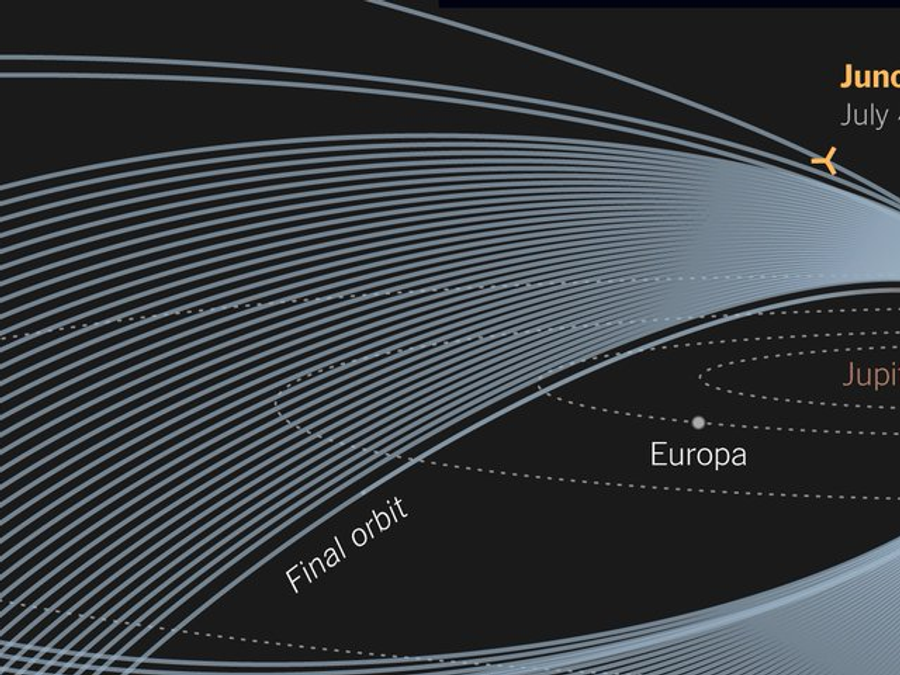
We have reached the cusp of the Constellation Age. A spacecraft is orbiting Jupiter with its electronics sealed inside a titanium vault, the only thing keeping it alive in the harshest radiation environment ever reached. A million miles from Earth, the James Webb Space Telescope unfolded itself through hundreds of single-point failures and is now returning the deepest images of the universe ever captured. And both Voyagers have now reached interstellar space, still transmitting nearly fifty years since launch.
Fast forward to 2050. A thousand people live on the Moon. A hotel operates in orbit. Robots have extensively explored the moons of Jupiter and Saturn. Half a million satellites route the data, payments, and logistics of the terrestrial economy beneath them.
Space radiation threatens every piece of silicon we send into orbit. Cosmic rays stream in from distant supernovae. Protons pour out of the Sun during solar storms. And among them, rarer but far more destructive, are heavy nuclei: iron and nickel stripped bare of their electrons, accelerated to near light-speed by events on the other side of the galaxy. A single heavy ion through the wrong microchip can freeze a processor, corrupt a command, or take a spacecraft permanently offline.
To defend against this, we harden our electronics. Hardening requires testing. Testing for the most damaging failures requires heavy-ion particle beams.
But demand for heavy-ion testing is growing much more quickly than supply. And advances in electronics are making testing harder and harder over time.
I: The Danger
The moment you leave Earth, you start losing protection from radiation. In the low orbits where the International Space Station flies, Earth's magnetic field still deflects most incoming radiation. But the shield is imperfect even there, and it weakens with altitude.
Radiation doughnuts
As you climb beyond LEO, you discover something remarkable. Starting around 1,000 kilometres up, Earth's magnetic field has captured radiation in two enormous doughnut-shaped regions around the planet: the Van Allen belts. For billions of years, the Van Allen belts have been intercepting incoming radiation that would otherwise reach the Earth’s surface.

The inner belt is mostly protons. When cosmic rays slam into the upper atmosphere, the collisions knock out neutrons. Some of those neutrons escape upward into the field, decay into protons along the way, and get trapped. The outer belt, stretching from around 13,000 to 60,000 kilometres out, is mainly high-energy electrons. Low-energy electrons drift in from the solar wind, and plasma waves inside the magnetosphere whip them up to dangerous speeds.
And, for the same reason these belts protect us on the ground, they become a serious hazard when we enter them. Inside them, radiation intensity is orders of magnitude higher than in the orbits below: they contain concentrated, energetic particles that can penetrate shielding and damage electronics in ways the mild doses at ISS altitude never would.
A spacecraft climbing to the Moon must pass directly through both belts. The Apollo missions planned their trajectories specifically to spend as little time in the belts as possible. For the next generation of lunar spacecraft, carrying more powerful and more vulnerable electronics, the passage will be no less dangerous.
Danger beyond doughnuts
Beyond the belts, you're on your own. The Sun throws off solar storms with little warning, blasting high-energy protons and heavier ions into space for hours or days at a time. Space weather forecasters can sometimes see them coming, but not reliably enough to count on.
Behind the flares, there's a constant background of radiation. Galactic cosmic rays arrive from outside the Solar System. They are mostly protons, accelerated to enormous energies by supernovae. They’ve been travelling for millions of years, and they can arrive from any direction. They come from all across the Milky Way.
Two mechanisms
Total Ionising Dose (TID) is the slow killer. Damage is done gradually through cumulative build-up of charge in a chip’s oxide layers, shifting voltages and increasing leakage of current. Single Event Effects (SEE) are the knockout punch. They’re sudden disruptions due to a one-off particle strike. A single ion passing through a transistor can deposit enough charge to flip a memory bit from zero to one or vice versa, draw destructive current from the rest of a circuit (aka, latchup), or knock out a transistor.
If TIDs are severe sunburn, SEEs are lightning strikes. We need to harden spacecraft electronics against both.
Solar wind, with Earth centre-right

II: Rad-hard
Every piece of electronics that leaves Earth's atmosphere needs to be built or qualified to withstand the particle bombardment that never stops. The industry calls it "rad-hard”; radiation-hardened.
Rad-hardness is tested by firing particle beams at components and seeing whether they hold up under particle bombardment. Proton beams qualify hardware against the recoverable bit flips that happen constantly. Heavy-ion beams qualify hardware against the rare strikes that destroy a device outright.
Different damage mechanisms demand different tests. For TID — the slow cumulative dose that shifts a chip's voltages over years — the industry uses Cobalt-60 gamma sources. For the everyday SEEs that flip memory bits, engineers fire protons.
Heavy-ion beams
For the most destructive SEEs, heavy-ion beams are the gold standard. A proton is a single hydrogen nucleus. It’s the lightest atomic nucleus there is. High-energy protons can trigger destructive failures indirectly, when they collide with atoms inside a chip and kick out heavier fragments. But every collision is different — different fragments, different energies, different directions — so you can't use protons to systematically map a device's breaking points. To reliably reproduce the full envelope of destructive failures, you need the dense ionisation track that only a heavy nucleus leaves behind directly. Heavy-ion accelerators are built to fire the same heavy nuclei that supernovae forge and scatter across the galaxy.
III: The Shortfall
Market expansion
There are about 15,000 satellites in orbit today. By 2030, around 100,000. By 2040, over half a million. These satellites are critical to the functioning of the modern world. They run GPS. They synchronise banking networks and time power grids. They route air traffic and guide agricultural machinery. When you swipe a credit card, a satellite often makes sure the charge goes through.
That is just satellites. Commercial space stations are under construction to replace the International Space Station. NASA's Artemis programme is building permanent lunar infrastructure, with crewed landings from 2028 and a surface base to follow. A senior European Space Agency scientist, Bernard Foing, projects roughly a thousand people living on the moon in 2050, including families.
And the missions themselves are pushing deeper into space, making radiation-induced failure increasingly expensive. NASA’s Europa Clipper launched in 2024 and is now cruising toward Jupiter to look for life beneath the ice of its moon Europa. The journey runs straight through Jupiter's magnetosphere, one of the harshest radiation environments in the solar system. And NASA’s Dragonfly, launching in 2028, is a nuclear-powered rotorcraft that will spend years hopping across the surface of Saturn's largest moon, Titan, sampling its methane lakes and organic chemistry. You can't ship a replacement component for these missions.
Demand vs. supply
As the market expands, the testing infrastructure is not keeping up. There is no substitute for putting hardware in a particle beam and seeing what breaks.
Fifteen facilities across the US provide radiation testing at the level space hardware demands. Most are repurposed physics labs or cancer treatment centres renting out beam time on the side. The vast majority of all heavy-ion beam hours come from just three: Texas A&M University, Brookhaven National Laboratory, and the Lawrence Berkeley National Laboratory.
As far back as 2018, the National Academies published a report on US radiation testing that urged infrastructure expansion. Its best-case scenario was a doubling of heavy-ion beam capacity. Even then, the authors warned, it might not keep pace with demand. Eight years later, the market’s expansion shows how inadequate a 2x increase will be.
The 2019 Analysis of Alternatives, commissioned by the Department of Defense, estimated existing US facilities provided roughly 5,000 hours of heavy-ion beam time per year against a latent demand of approximately 30,000 hours. The precise demand number is contested, but every serious assessment since has reached the same conclusion: supply is structurally short.
Since then, one new facility has opened: Michigan State's Single Event Effects beamline at the Facility for Rare Isotope Beams, which came online in late 2025. It adds around 6,000 heavy-ion beam hours a year. Brookhaven National Lab has proposed a second dedicated beamline that would add another 5,000 hours, but it is still awaiting funding and would take three to four years to build. That is it. Two facilities, one of which does not yet exist, against a demand curve that is growing by orders of magnitude.
Critically, the existing supply is slowly eroding. Indiana University's cyclotron, which provided both proton and limited heavy-ion testing, shut down in 2014 after its cancer treatment revenues dried up. Many of the accelerators still running are 30 to 55 years old. The workforce that operates them is ageing, and retiring operators take decades of irreplaceable knowledge with them.
A deepening problem
Meanwhile, the hardware is getting harder to test. Shrinking transistors mean less charge needed to flip a bit. Particles that a 1970s chip would have shrugged off can now take down a modern one. Voyager was built in the 1970s with about 69 kilobytes of memory. By comparison, a modern smartphone has roughly a million times more. That simplicity is part of why it's still alive, nearly fifty years in. Modern spacecraft carry vastly more computing power, making them vastly more vulnerable. As transistors shrink, the charge needed to flip a bit shrinks with it. The existing test beams cannot always penetrate deep enough to reach the sensitive parts buried inside the stack.
And the hardware is facing a harsher space environment than anyone planned for. In 2019, an international panel forecast that Solar Cycle 25 would be weak, similar to the previous cycle, which had been the quietest in a century. The commercial testing baselines for most LEO constellations were based on these predictions. In October 2024, radiation peaked 40% above that forecast. More sunspots means more solar flares, more coronal mass ejections, more energetic particles hitting everything in orbit.
When the bough breaks…
So here’s the status quo. Every piece of electronics sent into space needs to be rad-hard. Demand for radiation testing is growing by orders of magnitude. The hardware is getting harder to test, and the environment is getting harsher. And the supply of radiation testing is on its knees.
IV: The Workaround
To sidestep supply problems, satellite operators have started using commercial off-the-shelf parts (COTS). These components haven’t been qualified to heavy-ion testing standards, but they are dramatically cheaper and available now. If a satellite fails, launch a replacement on the next Falcon 9. SpaceX's Starlink constellation runs on exactly this approach. It makes sense if you’re only sending satellites into LEO, where the magnetosphere still offers some protection.
But the maths changes beyond LEO. SpaceX is already launching Falcon 9 rockets every two to three days, each one carrying around 25 Starlink satellites, at ~$10-15 million per launch. A satellite fails, and it gets replaced on the next routine batch. No special mission, no schedule change. A probe fails en route to Jupiter, and the replacement takes a decade to build, test, and deliver at a cost of hundreds of millions. A lander fails on the lunar surface, and there is no backup sitting on the pad.
The moment you’re sending humans, using off-the–shelf parts becomes reckless. If a crewed spacecraft fails due to radiation, people can die.
SpaceX’s cyclotron
In February 2026, SpaceX announced it had bought a 230 MeV cyclotron for a new testing facility in Florida. The facility will bring proton SEE testing in-house for Falcon, Dragon, Starship, Starlink, Starshield, and the Human Landing System.
The machine is a proton accelerator. It tests hardware against the bit flips that constant proton bombardment inflicts in LEO. For the destructive effects, only heavy ions will do, and SpaceX cannot produce heavy ions in Florida. They will still need to ship hardware to Texas A&M or Berkeley and wait in line. Texas A&M alone tested nearly a hundred components for Crew Dragon in the three years before the first crewed flight.
The world's most valuable private company has bought its own accelerator for rad-hardening, and it’s still dependent on a handful of national-lab cyclotrons built for nuclear physics in the 1970s.

V: The Race
SpaceX’s cyclotron purchase is a harbinger: the industry is becoming dangerously bottlenecked. In response, the supply side is searching for new solutions.
RADNEXT
The biggest effort to expand testing capacity is RADNEXT, an EU-funded network that pools access to more than twenty irradiation facilities across Europe. Over four years, the project awarded more than 6,000 hours of beam time across proton, heavy ions, and mixed fields. Heavy ions are the scarcest line item; the project’s own coordinators flag heavy-ion opportunities as the hardest to meet. Its successor, RADNEXT 2030, is expanding further. But even transplanting the entire network to the United States would not close the heavy-ion shortfall.
Compact laser-plasma accelerators
The most promising new entrant is a compact laser-plasma accelerator that fits inside a shipping container. In November 2025, TAU Systems produced the first electron beam from a commercial laser wakefield accelerator at its facility in Carlsbad, California. They signed the lease barely two years earlier. Two months later, Northrop Grumman demonstrated its own prototype using the same underlying technology, partnered with Lawrence Berkeley and Vanderbilt. Both efforts sit under DARPA's ASSERT programme: a $50M+ push, running since 2023, to build laboratory-scale alternatives to heavy-ion facilities. The speed of development is striking, and there's good reason to believe these systems will become a genuine new source of capacity.
But the path from credible concept to certified testing modality is long and uncertain. The core claim – that ultrashort electron pulses can reproduce the device-level effects of heavy-ion strikes – has not yet been validated against conventional heavy-ion results in published literature. And the governing industry standard for radiation testing explicitly excludes pulsed beams. Defence programmes, still the largest share of the market, could accept results under their own qualification frameworks. But building that evidence base is itself a multi-year process. And for the commercial satellite sector, where the growth is fastest, there is no shortcut: they need a new standard written.
Everything comes back to time. New testing modalities need certification pipelines that do not yet exist. Operators have to be trained. And the missions are not waiting. Artemis IV is targeting a crewed lunar landing in 2028. The satellites are launching. The transistors are shrinking.
VI: The Fix
For decades, nobody needed to build more heavy-ion beam time. The cyclotrons that do this work were built for nuclear physics. Radiation testing was a side job, a few hundred hours a year bought on someone else's machine. When the space industry was launching a few dozen satellites annually, that arrangement held. It doesn’t hold when the industry is launching thousands, sending crews to the Moon, and putting hardware beyond the reach of any replacement mission.
A dedicated testing accelerator wouldn’t look like the inherited infrastructure the industry runs on today. No competing with nuclear physicists for beam time. No depending on a hospital's chemotherapy revenue to keep the lights on. No fitting radiation campaigns into someone else's schedule. A purpose-built facility means testing throughput designed in from the start: faster turnaround between campaigns, higher utilisation, scheduling that serves the space industry rather than borrowing from another one.
Building a dedicated facility will be critical to ushering in the Constellation Age. What will this age bring us? A lunar habitat. A terraformed Mars. And a probe hardened for the twenty-year crossing to Proxima Centauri. But for the moment, the Constellation Age is waiting in line.